
The AI Middle Powers Take Center Stage?
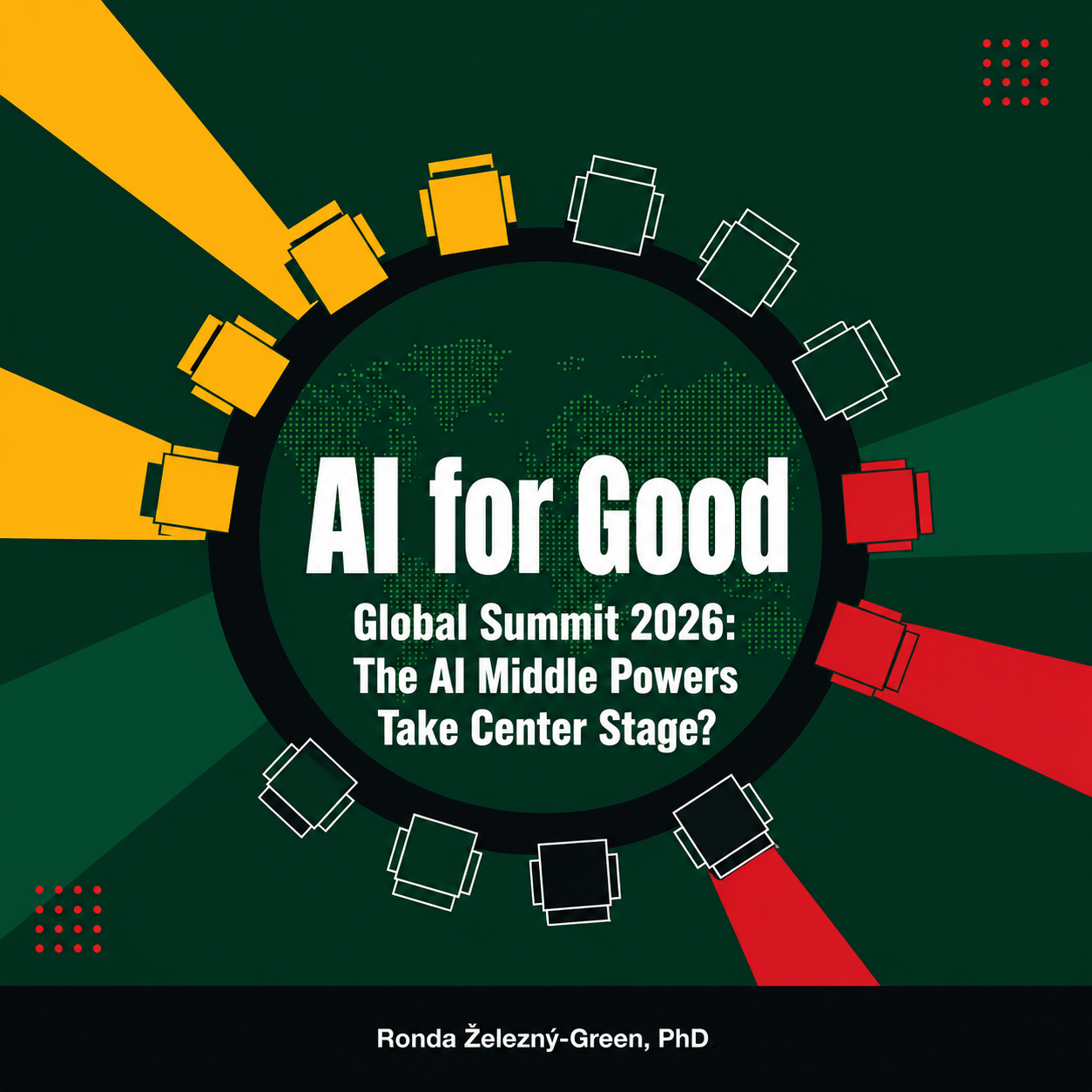
The AI for Good Global Summit begins today,7 July, and runs untill 10 July at the Palexpo in Geneva, and this year it is accompanied by something genuinely new: the AI for Good Global Commission, launched by the ITU and the UN on 2 July. Co-chaired by Rwandan President Paul Kagame and Salesforce CEO Marc Benioff, with ITU Secretary-General Doreen Bogdan-Martin as Vice-Chair, the Commission brings together 44 founding members as full members of a formal governance body. The ITU’s near-universal membership gives this body a legitimacy claim most Western-led governance efforts simply cannot match, and the founding member states including: Rwanda, Nigeria, Kazakhstan, Iceland, Namibia and Singapore, are countries that have thought seriously about what it means to govern AI from positions outside the US-China axis. For the first time, the leaders of frontier AI labs, NVIDIA, Amazon, Microsoft, Anthropic and Cohere, sit alongside presidents and prime ministers in a structure designed to produce what I hope will be actionable outputs: reports, recommendations, and voluntary commitments reviewed quarterly.
I have been following AI governance long enough to know that convening power and governance power are not the same thing. Bringing the right people into a room does not automatically mean the right decisions come out of it, especially when the members represent wildly different interests and wildly different levels of leverage.
I can’t be in Geneva this week, but what I am genuinely hoping for is that the Commission becomes a meaningful forum for middle-power participation in AI governance. Not a space where the countries and institutions with the most resources quietly shape the agenda while everyone else ratifies it. The countries with the most at stake in how AI is governed, the ones who did not build the frontier models and do not control the compute, deserve more than a seat at a table where the terms are already set.
Voluntary commitment architecture is only as strong as what sits behind it. Quarterly meetings and public outputs are a start. Whether those outputs carry real weight for the countries that need them most is what I’m hoping for.
I will be watching the summit closely, and I will be honest about what comes out of it. Please keep following my blog for the updates as they emerge!
Which AI middle power do you think can most influence conversations?