
Off the Treadmill: Time Sovereignty for Women Learners in the AI Era
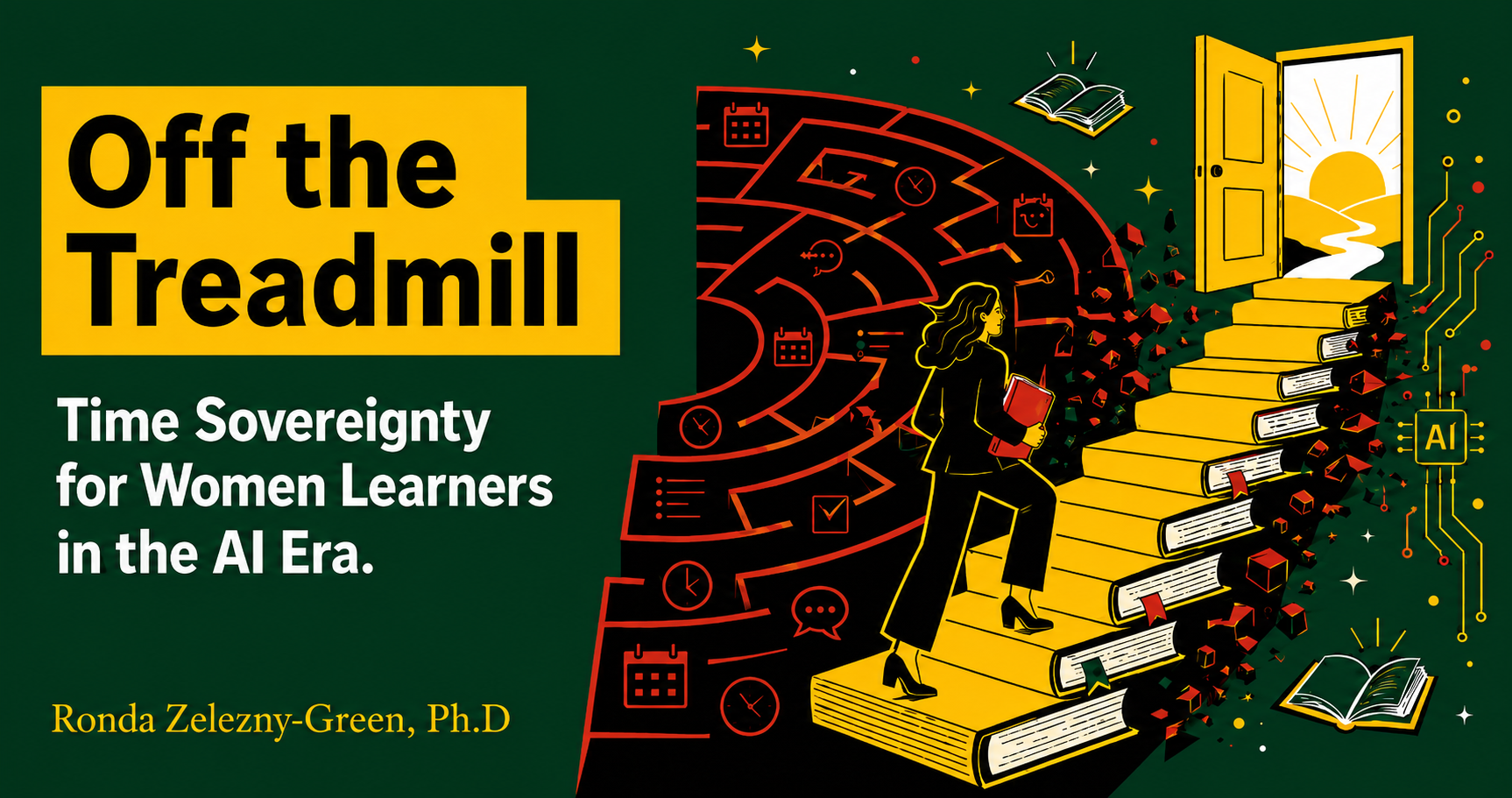
We keep selling AI as a time-saver. But as a female learner, I’m observing that time saved is rarely time kept.
I want to start with a confession, because I am living the thing I am about to argue.
These past months I have leaned on AI tools to compress the work that used to eat my evenings: summarizing a dense report, drafting a first pass, untangling a calendar. And every single time, the hours I clawed back did not stay mine. They were gone almost before I noticed them, reabsorbed into the next deadline, the next ask, the next thing. I have had to consciously, sometimes stubbornly, work to keep a sliver of that time as my own. If I, with all my privileges, have to fight for it, I think often about the women whose learning I have spent twenty years studying.
Here is the reframe I keep coming back to. We talk about AI in online learning as though its great gift is speed. Faster feedback, faster drafting, faster paths through a course. But for Global Majority women, speed has never been the binding constraint. Time has. And those are not the same thing.
The IFC and Coursera study “Women and Online Learning in Emerging Markets”, which I had the privilege of contributing practitioner insights and discussing at the European Commission’s Digital2Equal InfoPoint conference in 2023, makes this plain. Surveying roughly 10,000 learners across Egypt, India, Mexico, and Nigeria, it found that women spend less time on the platform per session and are online fewer days per week than men. When Coursera asked inactive learners why, 82 percent of women cited lack of time, and women were twice as likely as men to point to family obligations as the reason. Fifty-seven percent of women completed their paid courses, against 64 percent of men. That gap has little to do with how badly women want to learn, and everything to do with how little say they have over where their hours go.
And yet the same report shows the other half of the truth. Many women told researchers that the pandemic, by eliminating their commute and shrinking their social obligations, simply left them with more time, which they poured straight into learning. Forty-five percent of women, and 60 percent of women caregivers, said they would have had to postpone their studies or abandon them entirely without the online option.
So time, when it is freed and when it is protected, is transformative. The danger is that AI frees it and the world immediately claims it back.
This is why I have started thinking about time sovereignty as a piece of AI sovereignty, not separate from it. My throughline has always been governance over mere access: adopting a tool without the power to interrogate it just deepens dependency. Time is part of that governance. If an AI tutor halves the time a woman in Lagos or Oaxaca needs to grasp a concept, the question is not only whether the tool is accurate or in her language or built for her device, though all of that matters enormously. The question is also: whose claim wins on the time it gives back? Hers, or the household’s, the employer’s, the platform’s nudge to start the next module?
A tool that saves time but cannot help defend it is not liberating. It is a faster treadmill.
So I am asking three things.
To anyone who talks about AI’s value to women learners: stop leading with speed. Ask instead what protects their time, because protected time, not saved time, is where the gain actually lives.
To anyone who wants the evidence rather than my word for it: sit with the IFC and Coursera report. The numbers on completion, on caregiving, on funding are sobering, and they are specific.
And to anyone building learning tools for the Global Majority: design for time sovereignty. Treat a woman’s reclaimed hour as something to be defended, not refilled. Build the off-ramp, the pause, the “you have done enough today,” with the same care you give the algorithm. Sovereignty belongs in the tool from the start.
I am still working this out in my own days, so tell me, especially my female readers/learners: where have you seen time saved actually stay saved, and where did it slip away?