
The Most Important Data Career Almost No One Is Naming
I spent part of last week at The Gathering 2026, the AUNTIE Tech Collective retreat, and I have been turning one idea over ever since.
AUNTIE stands for Advancing Unity for Natives in Technology, Innovation and Excellence. It is a multigenerational collective hosted by AISES that supports Indigenous woman, girls, non-binary and Two-Spirit people across the whole arc of a tech life, from middle school clubs through to established professionals. I facilitated an AI session for the AUNTIE Advancement Lab back in March. As a woman of Lumbee descent, I keep returning to that community because it is one of the few rooms where my ancestry and my professional work are the same conversation.
The session that has stayed with me was billed as a technical session: Indigenous Data Sovereignty. Kai Two Feathers Orton (Innuinait, Niimíipuu, Nēhiyawak, Tłı̨chǫ), Senior AI Governance Lead at RTI International. Paula Starr (Cherokee), Chief Information Officer of the Cherokee Nation. Sal Kimmich (Cherokee Nation, Western Band), founder of Clewline and Policy Manager at OpenUK.
Not a cultural session. Not a values conversation to warm the room up before the real content. Three people whose actual paid jobs are governance, sovereignty controls, and technology decision-making for a nation of 460,000 citizens.
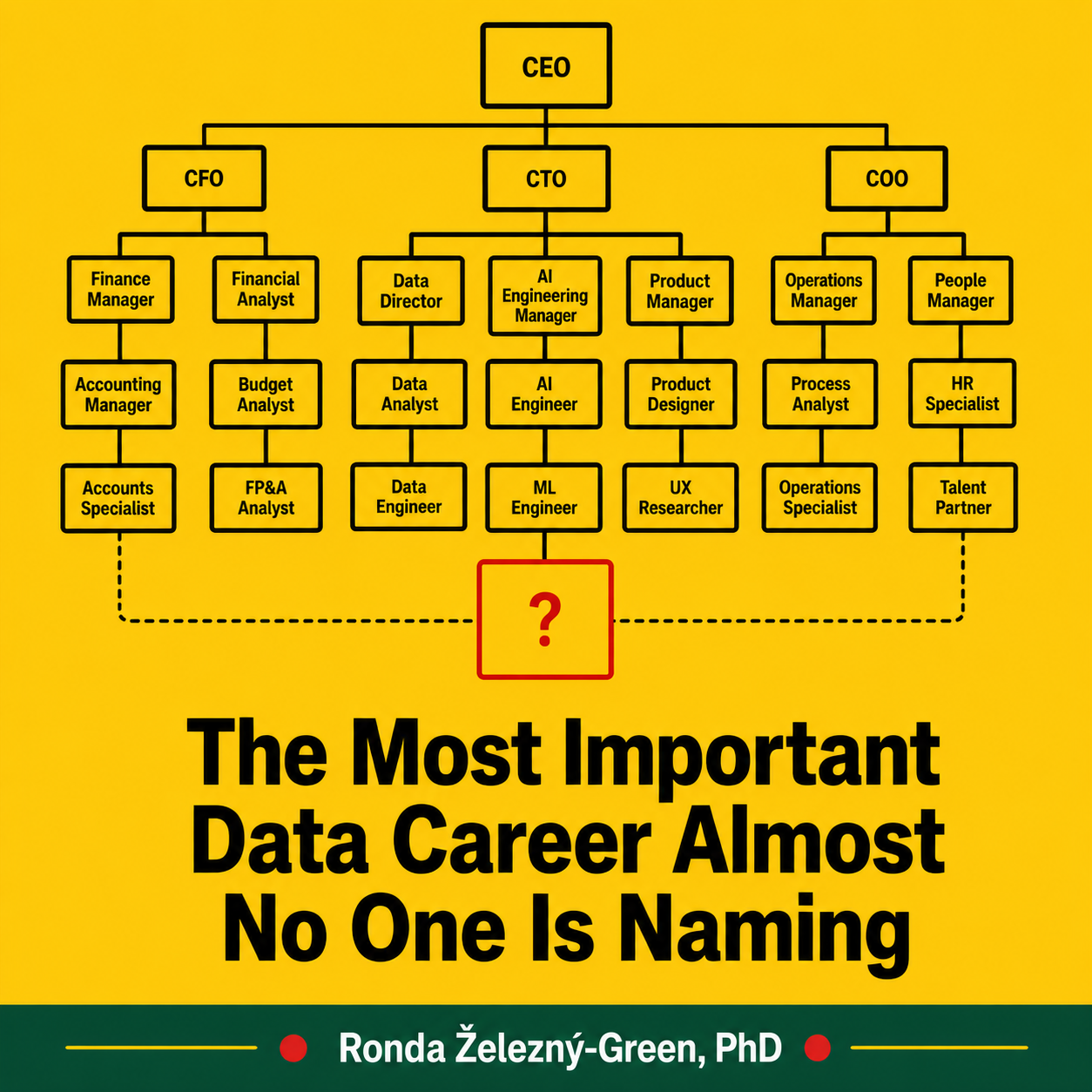
And it was Paula Starr who named the thing I have not been able to stop thinking about. She talked about data stewardship as a job. A role that Native nations need people trained for and hired into.
Here is why that landed so hard.
Almost every conversation I am invited into right now is about getting people into AI. Prompt courses. AI literacy workshops. Upskilling programmes. I build and deliver some of that work myself, so this is not a complaint from the sidelines. But the role that determines whether any of it can be trusted is barely being named as a career at all.
I want to be precise, because there is a complication. “Data steward” already exists as a job title. Thomson Reuters is advertising for a Senior Data Steward in Bangalore as I write this, working on data quality remediation, data catalogue maintenance, and compliance with internal data standards. That work matters. It is also a narrow slice of what the CARE Principles for Indigenous Data Governance describe. CARE stands for Collective benefit, Authority to control, Responsibility, and Ethics, formalised by the Global Indigenous Data Alliance and set out by Stephanie Russo Carroll and colleagues in 2020. Responsibility in CARE is not a ticket queue. It means being accountable to the people the data came from, and to the generations who will inherit the consequences. The title exists. The job CARE describes has been hollowed out into compliance work.
Which brings me to a report that arrived in my inbox and made me understand what I had heard at the retreat.
It is called “Living well with data: Stewardship as a just and viable paradigm,” written by Reema Patel of Elgon Social Research and published in April 2026 with funding from the ESRC Digital Good Network. Patel maps ten mental models of data governance: data colonialism and feudalism, data ownership, data control, data technocracy, data liberation, data protection and rights, data justice, data sovereignty, data as culture, and data stewardship. Her argument is that the mental models we carry determine which problems we notice and which solutions feel possible at all. She makes the case for stewardship as a meta-model holding the others together, with data understood as a living system requiring care over time. She borrows David McCandless’s line about data being the new soil instead of the new oil, and she credits him for it.
Then she does something I have not seen anyone else do. She plots all ten models against the Overton window, the range of positions considered sayable in public and political discourse, as it stands in Anglo-American debate in 2026. Data ownership and data control sit comfortably inside it as conventional wisdom. Data justice, data sovereignty and data as culture are in the contested middle. Data stewardship, the model she spends the whole report arguing for, sits outside the window entirely, in the range she labels unthinkable.
So this is not my impression that nobody is talking about it. The person making the strongest case for stewardship has mapped exactly how far outside the conversation it currently sits.
Now hold that next to where Patel grounds her ethics. She builds stewardship on Ubuntu ethics from African philosophical tradition, “I am because we are.” On Indigenous perspectives, formalised through the CARE Principles. On nishkāma-karma from the Bhagavad Gita, action taken for collective good rather than personal return. She describes this grounding as a direct rejection of the individualistic, rights-based data models that dominate the Global North. And she is explicit that she offers stewardship as a rediscovery of a foundational concept, not an invention.
Read those two facts together and the shape of the problem comes clear. The framework being proposed as the just and viable future of global data governance runs on ways of thinking that Global Majority and Indigenous communities have carried for generations. That framework is currently classed as unthinkable in Anglo-American policy discourse. And the role that would carry it out, the actual paid job, is almost nowhere on anybody’s workforce plan.
This is where the rest of that panel matters. Sal Kimmich’s company, Clewline, is built on the premise that sovereignty is a technical property. It offers self-hostable assessment tools for sovereignty gap analysis, taking organisations from policy to verified controls. That is the second half of what Starr was describing. Naming a steward is the first move. Giving that person something they can actually test, verify, and refuse on is what turns the title into a job. Otherwise, you have written a principle and hired nobody to enforce it.
Indian Country is further ahead here than most sectors. In October 2024, Principal Chief Chuck Hoskin Jr. issued an executive order on data sovereignty and self-governance, creating an AI, Data Sovereignty and Cybersecurity Task Force with Starr as chair. Its recommendations included governance committees, data literacy and outreach programmes, and a questionnaire that any company hoping to work with the Nation has to answer. At the Ai4 conference in 2025, Starr put the test plainly: “AI must serve the collective good and uphold Cherokee values.” At the National Indian Health Board’s 2025 Tribal Health Data Symposium, building tribal data workforce capacity was its own strand, with presenters pressing for investment in Tribal Colleges and Universities and for sustainable career pathways in health data.
Compare that with the pace elsewhere. The Data Tank, one of the few organisations running formal data stewardship training in Europe, put around thirty senior leaders through its bootcamps across the whole of 2024. Thirty. Against the volume of people being funnelled into generative AI courses every week, that number tells you where the sector has placed its bets.
This is the same argument I keep making about AI governance, arriving from a different direction. Access without governance produces dependency. And governance without people whose actual job is to hold it produces a policy document that nobody is accountable for. Somebody has to be responsible for the soil.
So let me put the question to you the way it was put to me in that room.
In your organisation, who holds this? Not who signed off the data policy. Who is paid, named and evaluated on caring for your data over time, on being answerable to the people it came from, and on having the standing to say no when a tool fails that test? If you cannot name the person, that is your finding.
And underneath it, the question Patel would want you to ask first. Which of those ten mental models are you actually operating from when you make decisions about data? Because whichever one it is, it is already deciding what you are able to see.