
THE CO-CREATOR: AI, EQUITY & POWER
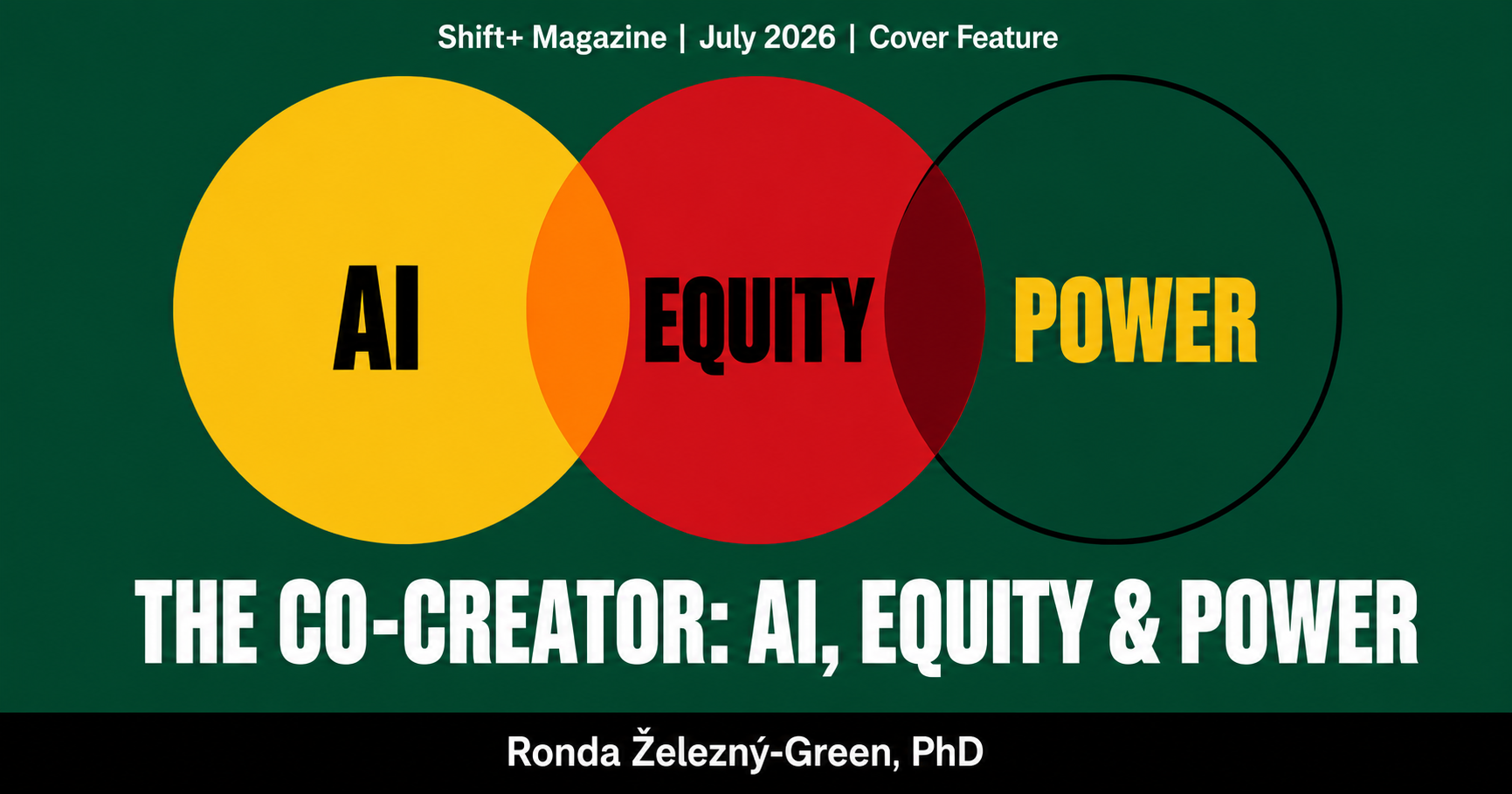
Equity in AI is not a checkbox. I have been saying this for a long time, but I got the opportunity to say it clearly again in an interview with Shift+ Technology Magazine this month, and I want to say it here too, with the full argument behind it.
The July 2026 issue features me on the cover in an exclusive interview on AI, equity, and power. The editors titled my section “The Co-Creator” co-creation is a conviction that came from years of fieldwork and frameworks for more just, people-centered international development .
The experiences that have shaped me most are the ones that refused to let me stay comfortable. Working with the Global e-Schools and Communities Initiative across Kenya and Tanzania was formative. It was never just about building mobile platforms. It was about sitting with teachers, listening to what they actually needed, and watching technology become meaningful only when it responded to real human needs. That same conviction has taken me from mobile learning initiatives in East Africa to global AI literacy programs reaching thousands of people across 40 countries, to research on how AI intersects with gender-based violence and systemic inequity. The through-line in all of it is one stubborn question: who gets left out?
In the interview I was asked to define what inclusive AI actually looks like in practice. Inclusive AI looks like communities being co-creators, not just end users or research subjects. It looks like the people closest to potential harm having a meaningful role in designing the safeguards. It looks like governance frameworks that embed cultural and contextual understanding into safety evaluations, not as an add-on but as a core requirement. And it means measuring equity as a concrete outcome. Inclusion that is not measured is inclusion that is merely claimed.
For leaders building AI products today, I gave three non-negotiables;
First, meaningful representation in the design process from the very beginning: not advisory panels consulted after decisions are made, but genuine co-creation with communities who represent the full range of people who will be affected.
Second, equity as a measurable outcome: adoption rates broken down by region, gender, and socioeconomic status, an equity index that surfaces gaps rather than obscures them.
Third, humility about speed: moving fast in the absence of inclusive design creates and encodes gaps.
The interview also gave me space to talk about something that drives me personally in this work. Thriving with ADHD has given me a firsthand education in what happens when systems are not designed with cognitive diversity in mind. I know what it feels like to encounter digital learning environments that assume a linear, sustained attention span and one-size-fits-all pacing. Those systems actively communicate that I do not belong. That experience has sharpened my instinct for design in ways I could not have manufactured any other way.
Am I optimistic? Cautiously, purposefully, yes. The same technologies that risk deepening inequality can also serve as powerful equalizers, if approached with intention and equity at the forefront. Across the Global Majority, practitioners, researchers, educators and policymakers are already doing this work, building the credible, experienced voices that belong in rooms where the definitions of safety and accountability are being written. This is also what drives my work at datocracy.ai. When those voices shape what gets built, the future of AI can genuinely belong to everyone.What non-negotiable would you add to my list?