
Access Without Power: What the UNESCO South Asia AI and Gender Report Actually Found
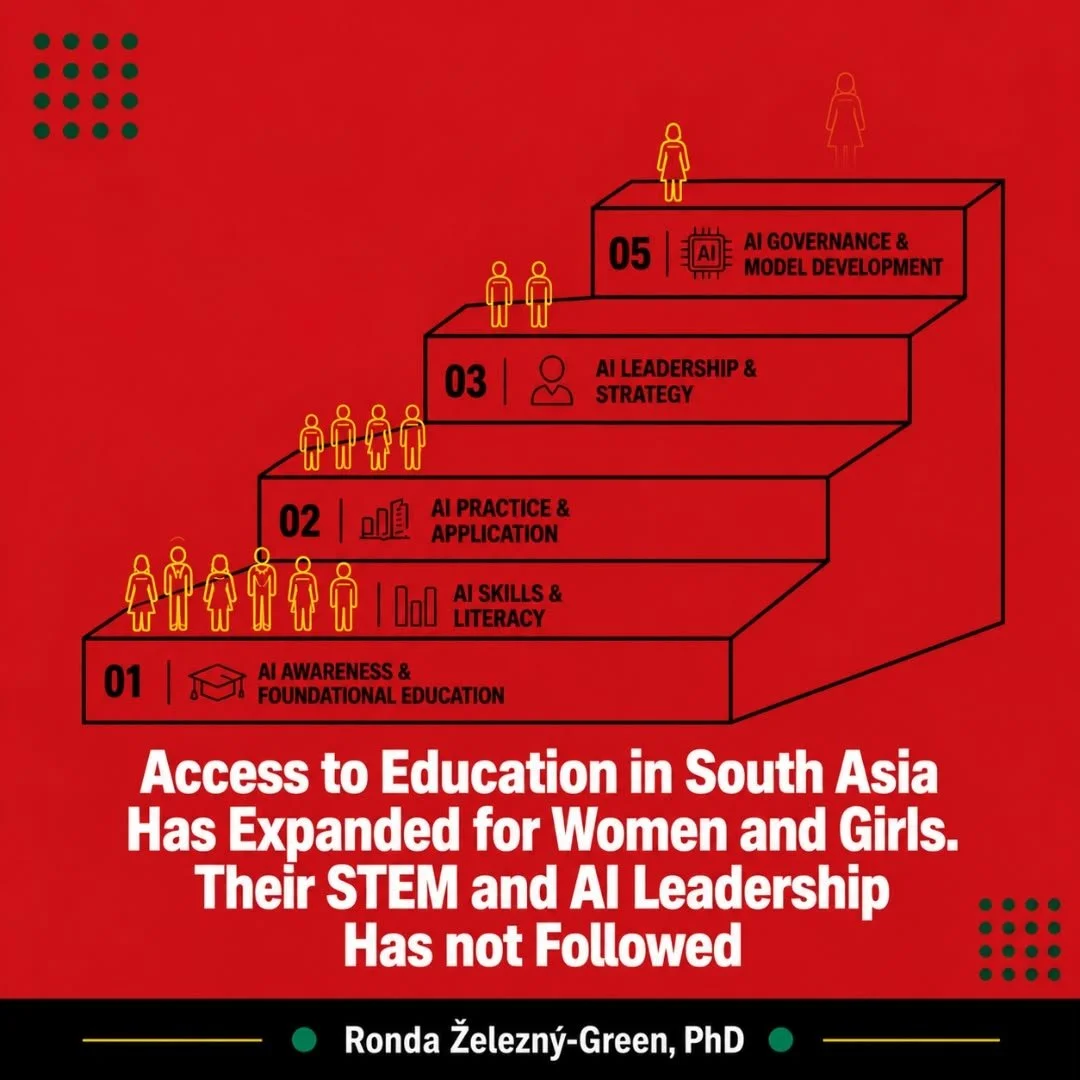
I recently read a statistic from a report titled Outlook Study on Artificial Intelligence and Gender in South Asia, and I want to share my thoughts.
In the Maldives, women make up nearly 78% of university students. In the same country, only about 2% of those students enrol in science and technology programmes.
This is a stark example of the oft-cited “pipeline problem”, and when I delved deeper into the report, a more complicated story emerged about getting more women into higher education.
The study, produced by the UNESCO Women for Ethical AI South Asia Chapter and launched in New Delhi on 9 July 2026, is the first regional assessment of women’s participation in AI across Bangladesh, Bhutan, India, Maldives, Nepal and Sri Lanka. It maps women’s participation across every stage of the AI ecosystem, from education and research to the workforce and entrepreneurship, and finds a pattern of accumulating barriers rather than a single point of exclusion.
Across South Asia, women account for only about one third of STEM students. But the headline enrolment numbers mask something more specific: An analysis of AI publications between 2015 and 2025 found that while 71.76% of publications across the six countries include at least one woman author, women hold only 26% of corresponding or primary authorship positions, the roles that reflect research leadership and intellectual ownership. In Bangladesh, male corresponding authors produce eight times more AI publications than women. In the Maldives, nearly 14 times more.
In the workforce, women are concentrated in upstream data preparation and downstream service functions. They are significantly underrepresented in model development, the stage where technical authority, innovation, intellectual property, and higher-value employment are concentrated. In entrepreneurship, only about 10% of AI start-ups in India have at least one woman founder, and fewer than 1% of India’s estimated 10,000 angel investors are women.
Dr Bhavani Rao, a UNESCO Chair on Gender Equality and Women’s Empowerment, named the problem clearly: “Women and girls in South Asia are being left out of the AI story, not because they lack ability, but because the systems around them have not been designed with them in mind.”
So while access to education in the region may have expanded at all levels for women and girls, in AI leadership, research ownership, and the stages of the pipeline where power and value are concentrated has not followed. Designing education systems that produce different outcomes requires interrogating the assumptions built into the education systems themselves.
The UNESCO report is a reminder that evidence developed to guide education system change is only the beginning. The question that follows is always: what do the systems around people actually make possible for them once that data has been crunched?