
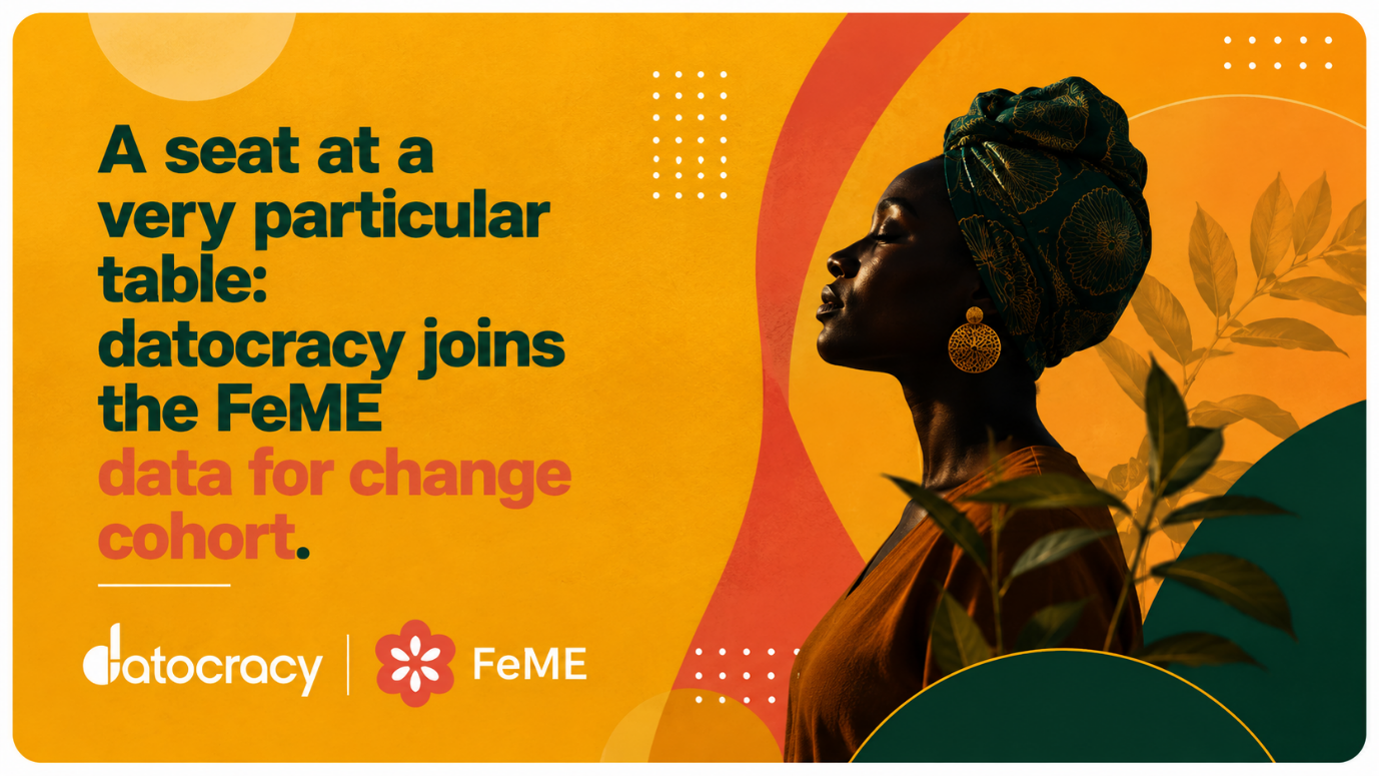
In early 2026, the Failure Modes of Engineering Network Plus (FeME), hosted by the University of Edinburgh with the University of Glasgow and Heriot-Watt, awarded seed funding to nineteen projects across four continents. The cohort runs from Machakos to Milpa Alta, from Fair Isle to Fancy, from a slum-based waste valorisation project in Kenya to a community climate-health watch in rural Uganda to Indigenous-led renewable energy monitoring in Yucatán. Eight of those projects sit in FeME’s Data for Change stream, all of them centring underrepresented or low-resource communities, most of them designed offline-first for places where connectivity is patchy and resources are scarce.
datocracy is one of the 19!!!
I want to sit with what that means for a moment, because the milestone is not really about us. FeME designed these seed funds to test, in their words, that small, well-supported projects can model how funding itself can be done differently. The company datocracy now keeps in this cohort, women and men leading work rooted in the communities most affected by climate change and biodiversity loss, is itself the point. This is not capacity building done to the Global Majority. It is datocracy in conversation with peers doing parallel, locally-rooted work.
Our project, led with LaunchHER Engineers’ Hub in Zambia, delivers blended training in responsible data storytelling for climate advocacy to women engineers across mining, energy, infrastructure, and agriculture. Zambia is facing acute climate pressures right now: droughts hitting agriculture, energy instability tied to hydropower dependence, environmental degradation from mining. The engineers positioned inside these sectors have deep technical capacity. What they rarely receive training in is how to translate that technical work into stories that move policymakers, communities, and media. That gap is what we are stepping into.
We begin deployment of our “How to Leverage Data and AI for Climate Action” course with the LaunchHER cohort in June 2026, building toward an in-person convening in Kitwe in August where twenty-five participants will gather to deepen practice and build peer networks. All materials will be openly licensed under CC-BY 4.0 so they can be adapted across the FeME network and beyond.
The course teaches what is rarely taught in engineering curricula: that data and AI are not neutral, that climate solutions can replicate harm if deployed carelessly, that “whose voices are missing?” is itself an engineering question.
This is datocracy’s first grant. I am not going to pretend that does not matter. It matters. But it matters less for the funding itself and more for what the funding signals: that a network built around feminist engineering methods, around the conviction that lived experience is technical expertise, has looked at what datocracy is building and decided to back it. That is not nothing. That is a particular kind of validation, from a particular kind of funder, and we do not take it for granted.
If you want to see the full cohort and the questions FeME is asking, the announcement is here. Training outputs from our stream will be shared publicly in October 2026, and we will be telling that story as it unfolds. And if you are working on data and AI capacity in low and middle income contexts, whether you are a funder, a delivery partner, or an organisation looking for thought partnership, get in touch. This is the conversation we are here to have.